
3.2 KiB
Math4121 Lecture 29
Continue on Measure Theory
Lebesgue Measure
Caratheodory's criterion:
S is Lebesgue measurable if for all A\subset S,
m_e(X) = m_e(X\cap S) + m_e(X\cap S^c)
Let \mathfrak{M} be the collection of all Lebesgue measurable sets.
\phi\in\mathfrak{M}\mathfrak{M}is closed under countable unions (proved last lecture)\mathfrak{M}is closed under complementation (\mathfrak{M}is a $\sigma$-algebra) (goal today)
Desired properties of a measure:
m(I)=\ell(I)for all intervalsI- If
\{S_n\}_{n=1}^{\infty}is a set of pairwise disjoint Lebesgue measurable sets, thenm\left(\bigcup_{n=1}^{\infty}S_n\right) = \sum_{n=1}^{\infty}m(S_n)
- If
R\subset S, thenm(S\setminus R) = m(S) - m(R)
Recall the Borel $\sigma$-algebra \mathcal{B} was the smallest $\sigma$-algebra containing closed intervals. Therefore \mathcal{B}\subset\mathfrak{M}.
Towards proving \mathfrak{M} is closed under countable unions:
Theorem 5.9 (Finite union/intersection of Lebesgue measurable sets is Lebesgue measurable)
Any finite union/intersection of Lebesgue measurable sets is Lebesgue measurable.
Proof:
Suppose S_1, S_2 is a measurable, and we need to show that S_1\cup S_2 is measurable. Given X, need to show that
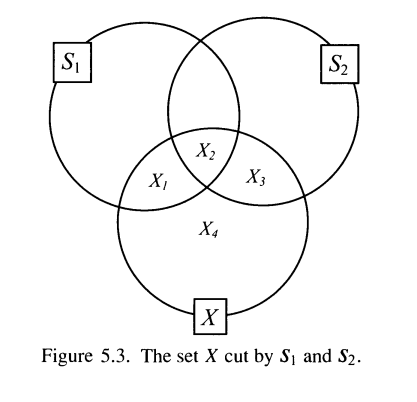
m_e(X) = m_e(X_1\cup X_2\cup X_3)+ m_e(X_4)
Since S_1 measurable, m_e(X_1\cup X_2\cup X_3)=m_e(X_3)+m_e(X_1\cup X_2).
Since S_2 measurable, m_e(X_3\cup X_4)=m_e(X_3)+m_e(X_4).
Therefore,
\begin{aligned}
m_e(X) &= m_e(X_1\cup X_2\cup X_3) + m_e(X_4) \\
&= m_e(X_1\cup X_2) + m_e(X_3)+m_e(X_4) \\
&= m_e(X_1\cup X_2) + m_e(X_3\cup X_4) \\
&= m_e(X)
\end{aligned}
by measurability of S_1 again.
QED
Theorem 5.10 (Countable union/intersection of Lebesgue measurable sets is Lebesgue measurable)
Any countable union/intersection of Lebesgue measurable sets is Lebesgue measurable.
Proof:
Let \{S_j\}_{j=1}^{\infty}\subset\mathfrak{M}. Definte T_j=\bigcup_{k=1}^{j}S_k such that T_{j-1}\subset T_j for all j.
And U_1=T_1, U_j=T_j\setminus T_{j-1} for j\geq 2.
Then \bigcup_{j=1}^{\infty}S_j=\bigcup_{j=1}^{\infty}T_j=\bigcup_{j=1}^{\infty}U_j. Notice that \{U_j\}_{j=1}^{\infty} are pairwise disjoint, and \{T_j\}_{j=1}^{\infty} are monotone.
Let X have finite outer measure. Since U_n is measurable,
\begin{aligned}
m_e(X\cap T_n) &= m_e(X\cap T_n\cap U_n)+ m_e(X\cap T_n\cap U_n^c) \\
&= m_e(X\cap U_n)+ m_e(X\cap T_{n-1}) \\
&= \sum_{j=1}^{n}m_e(X\cap U_j)
\end{aligned}
Since T_n is measurable and T_n\subset S, S^c\subset T_n^c. m_e(X\cap T_n^c)\geq m_e(X\cap S^c).
Therefore,
m_e(X)=m_e(X\cap T_n)+m_e(X\cap T_n^c)\\
\geq \sum_{j=1}^{n}m_e(X\cap U_j)+m_e(X\cap S^c)
Take the limit as n\to\infty,
\begin{aligned}
m_e(X) &\geq \sum_{j=1}^{\infty}m_e(X\cap U_j)+m_e(X\cap S^c) \\
&= m_e(\bigcup_{j=1}^{\infty}(X\cap U_j))+m_e(X\cap S^c) \\
&= m_e(X\cap S)+m_e(X\cap S^c) \\
&\geq m_e(X)
\end{aligned}
Therefore, m_e(X\cap S)=m_e(X).
Therefore, S is measurable.
QED
Corollary from the proof
Every open or closed set is Lebesgue measurable.
(Every open set is a countable union of disjoint open intervals)