
5.5 KiB
CSE559A Lecture 21
Continue on optical flow
The brightness constancy constraint
I_x u(x,y) + I_y v(x,y) + I_t = 0
Given the gradients I_x, I_y and I_t, can we uniquely recover the motion (u,v)?
- Suppose
(u, v)satisfies the constraint:\nabla I \cdot (u,v) + I_t = 0 - Then
\nabla I \cdot (u+u', v+v') + I_t = 0for any(u', v')s.t.\nabla I \cdot (u', v') = 0 - Interpretation: the component of the flow perpendicular to the gradient (i.e., parallel to the edge) cannot be recovered!
Aperture problem
- The brightness constancy constraint is only valid for a small patch in the image
- For a large motion, the patch may look very different
Consider the barber pole illusion
Estimating optical flow (Lucas-Kanade method)
- Consider a small patch in the image
- Assume the motion is constant within the patch
- Then we can solve for the motion
(u, v)by minimizing the error:
I_x u(x,y) + I_y v(x,y) + I_t = 0
How to get more equations for a pixel? Spatial coherence constraint: assume the pixel’s neighbors have the same (𝑢,𝑣) If we have 𝑛 pixels in the neighborhood, then we can set up a linear least squares system:
\begin{bmatrix}
I_x(x_1, y_1) & I_y(x_1, y_1) \\
\vdots & \vdots \\
I_x(x_n, y_n) & I_y(x_n, y_n)
\end{bmatrix}
\begin{bmatrix}
u \\ v
\end{bmatrix} = -\begin{bmatrix}
I_t(x_1, y_1) \\ \vdots \\ I_t(x_n, y_n)
\end{bmatrix}
Lucas-Kanade flow
Let $A= \begin{bmatrix} I_x(x_1, y_1) & I_y(x_1, y_1) \ \vdots & \vdots \ I_x(x_n, y_n) & I_y(x_n, y_n) \end{bmatrix}$
$b = \begin{bmatrix} I_t(x_1, y_1) \ \vdots \ I_t(x_n, y_n) \end{bmatrix}$
$d = \begin{bmatrix} u \ v \end{bmatrix}$
The solution is d=(A^T A)^{-1} A^T b
Lucas-Kanade flow:
- Find
(u,v)minimizing\sum_{i} (I(x_i+u,y_i+v,t)-I(x_i,y_i,t-1))^2 - use Taylor approximation of
I(x_i+u,y_i+v,t)for small shifts(u,v)to obtain closed-form solution
Refinement for Lucas-Kanade
In some cases, the Lucas-Kanade method may not work well:
- The motion is large (larger than a pixel)
- A point does not move like its neighbors
- Brightness constancy does not hold
Iterative refinement (for large motion)
Iterative Lukas-Kanade Algorithm
- Estimate velocity at each pixel by solving Lucas-Kanade equations
- Warp It towards It+1 using the estimated flow field
- use image warping techniques
- Repeat until convergence
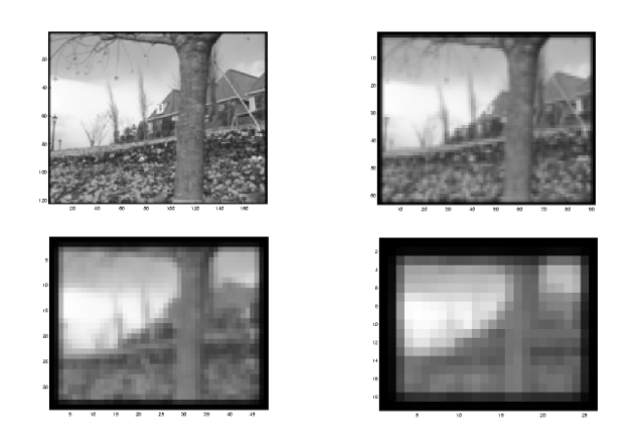
Iterative refinement is limited due to Aliasing
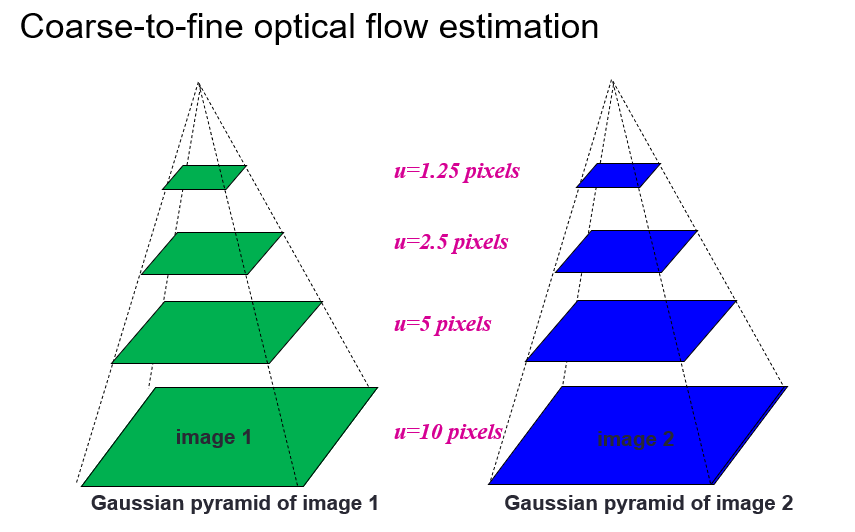
Coarse-to-fine refinement (for large motion)
- Estimate flow at a coarse level
- Refine the flow at a finer level
- Use the refined flow to warp the image
- Repeat until convergence
Representing moving images with layers (for a point may not move like its neighbors)
- The image can be decomposed into a moving layer and a stationary layer
- The moving layer is the layer that moves
- The stationary layer is the layer that does not move
SOTA models
2009
Start with something similar to Lucas-Kanade
- gradient constancy
- energy minimization with smoothing term
- region matching
- keypoint matching (long-range)
2015
Deep neural networks
- Use a deep neural network to represent the flow field
- Use synthetic data to train the network (floating chairs)
2023
GMFlow
use Transformer to model the flow field
Robust Fitting of parametric models
Challenges:
- Noise in the measured feature locations
- Extraneous data: clutter (outliers), multiple lines
- Missing data: occlusions
Least squares fitting
Normal least squares fitting
y=mx+b is not a good model for the data since there might be vertical lines
Instead we use total least squares
Line parametrization: ax+by=d
(a,b) is the unit normal to the line (i.e., a^2+b^2=1)
d is the distance between the line and the origin
Perpendicular distance between point (x_i, y_i) and line ax+by=d (assuming a^2+b^2=1):
|ax_i + by_i - d|
Objective function:
E = \sum_{i=1}^n (ax_i + by_i - d)^2
Solve for d first: d =a\bar{x}+b\bar{y}
Plugging back in:
E = \sum_{i=1}^n (a(x_i-\bar{x})+b(y_i-\bar{y}))^2 = \left\|\begin{bmatrix}x_1-\bar{x}&y_1-\bar{y}\\\vdots&\vdots\\x_n-\bar{x}&y_n-\bar{y}\end{bmatrix}\begin{pmatrix}a\\b\end{pmatrix}\right\|^2
We want to find N that minimizes \|UN\|^2 subject to \|N\|^2= 1
Solution is given by the eigenvector of U^T U associated with the smallest eigenvalue
Drawbacks:
- Sensitive to outliers
Robust fitting
General approach: find model parameters 𝜃 that minimize
\sum_{i} \rho_{\sigma}(r(x_i;\theta))
r(x_i;\theta): residual of x_i w.r.t. model parameters \theta
\rho_{\sigma}: robust function with scale parameter \sigma, e.g., \rho_{\sigma}(u)=\frac{u^2}{\sigma^2+u^2}
Nonlinear optimization problem that must be solved iteratively
- Least squares solution can be used for initialization
- Scale of robust function should be chosen carefully
Drawbacks:
- Need to manually choose the robust function and scale parameter
RANSAC
Voting schemes
Random sample consensus: very general framework for model fitting in the presence of outliers
Outline:
- Randomly choose a small initial subset of points
- Fit a model to that subset
- Find all inlier points that are "close" to the model and reject the rest as outliers
- Do this many times and choose the model with the most inliers