 69174f2157
32 KiB
CSE4303 Introduction to Computer Security (Exam Review)
Details
Time and location
– In class exam – Thursday, 3/5 at 11:30 AM – What is allowed: - One 8.5" X 11" paper of notes, single-sided only, typed or hand-written
Topics covered:
– Security fundamentals – TCP/IP network stack – Crypto fundamentals – Symmetric key cryptography – Hash functions – Asymmetric key cryptography
Security fundamentals
Defining security
- Understand principles of security analysis
- The security of a system, application, or protocol is always relative to
- A set of desired properties
- An adversary with specific capabilities ("threat model")
- The security of a system, application, or protocol is always relative to
Key security concepts
C.I.A. triad:
- Integrity: Prevent unauthorized modification of data, and/or detect if modification occurred.
- ARP poisoning (ARP spoofing)
- Authentication codes
- Confidentiality: Prevent unauthorized parties from learning the contents of data (in transit or at rest).
- Packet sniffing / eavesdropping
- Data encryption
- Availability: Ensure systems and data are accessible to authorized users when needed.
- Denial-of-Service (DoS) / Distributed DoS (DDoS)
- Rate limiting + traffic filtering (often with DDoS protection/CDN)
Other security goals:
- Authenticity: identity of an entity (issuer of info/message) is verified
- Anonymity: identity of an entity remains unknown
- Non-repudiation: messages can't be denied or taken back (e.g. online transaction commitments)
Modeling attacks
Common components:
- System being attacked (usually a model, with assumptions and abstractions)
- Threat model
- Attack surface: what can be attacked
- Open ports and exposed services
- Public APIs and their parameters
- Web endpoints, forms, cookies
- File system permissions
- Hardware interfaces (USB, JTAG)
- User roles and privilege boundaries
- Attack vector: how the attacker attacks
- SQL injection via POST /login
- Phishing to steal credentials, then SSH login
- Buffer overflow in a network daemon
- Cross-site scripting through a comment field
- Supply-chain poisoning of a dependency
- Vulnerability: what the attacker can do
- Exploit: how the attacker exploits the vulnerability
- Damage: what the attacker can do
- Mitigation: mitigate vulnerability
- Defense: close vulnerability gap
Importance of correct modeling
- Attack-surface awareness guides defenses
- E.g. pre-Covid-19 vs. post-Covid attack surface of company servers
- Match resources to expected threat actors
- "Script kiddie": individual or group running off-the-shelf attacks
- Caveat: off-the-shelf attacks can still be quite powerful! Metasploit, Shodan, dark web market.
- "Insider attack": employee with access to internal machines/networks
- "Advanced Persistent Threat (APT)": nation-state level resources and patience
- All these threats have different motivations, require different defenses/responses!
- "Script kiddie": individual or group running off-the-shelf attacks
- Reevaluate often
- Threat capabilities change over time
TCP/IP network stack
Local and interdomain routing
- TCP/IP for routing and messaging
- BGP for routing announcements
Domain Name System
- Find IP address from symbolic name (cse.wustl.edu)
Layer Summary
Application: the actual sending message Transport (TCP, UDP): segment Network (IP): packet Data Link (Ethernet): frame
Types of Addresses in Internet
- Media Access Control (MAC) addresses in the network access layer
- Associated w/ network interface card (NIC)
- 00-50-56-C0-00-01
- IP addresses for the network layer
- IPv4 (32 bit) vs IPv6 (128 bit)
- 128.1.1.3 vs fe80::fc38:6673:f04d:b37b%4
- IP addresses + ports for the transport layer
- E.g., 10.0.0.2:8080
- Domain names for the application/human layer
- E.g., www.wustl.edu
Routing and Translation of Addresses
(All of them are attack surfaces)
- Translation between IP addresses and MAC addresses
- Address Resolution Protocol (ARP) for IPv4
- Neighbor Discovery Protocol (NDP) for IPv6
- Routing with IP addresses
- TCP, UDP for connections, IP for routing packets
- Border Gateway Protocol for routing table updates
- Translation between IP addresses and domain names
- Domain Name System (DNS)
Summary for security
- Confidentiality
- Packet sniffing
- Integrity
- ARP poisoning
- Availability
- Denial of service attacks
- Common
- Address translation poisoning attacks (DNS, ARP)
- Packet spoofing
- Core protocols not designed for security
- Eavesdropping, packet injection, route stealing, DNS poisoning
- Patched over time to prevent basic attacks
- More secure variants exist:
- IP
\toIPsec (IPsec is ) - DNS
\toDNSsec - BGP
\tosBGP
- IP
Crypto fundamentals
- Well-defined statement about difficulty of compromising a system
- ...with clear implicit or explicit assumptions about:
- Parameters of the system
- Threat model
- Attack surfaces
- ...with clear implicit or explicit assumptions about:
- Example: "A one-time pad cipher is secure against any cryptanalysis, including a brute-force attack, assuming:
- the key is the same length as the plaintext,
- the key is truly random, and
- the key is never re-used."
Common roles in cryptography
Alice and Bob: Sender and receiver
Eve: Adversary that can see but not create any packets
Mallory: Man in the middle, can create and modify packets
The message M is called the plaintext.
Alice will convert plaintext M to an encrypted form using an encryption algorithm E that outputs a ciphertext C for M.
Cryptography goals
Confidentiality:
- Mallory and Eve cannot recover original message from ciphertext
Integrity:
- Mallory cannot modify message from Alice to Bob without detection by Bob
Threat models
- Attacker may have (with increasing power):
- a) collection of ciphertexts (ciphertext-only attack)
- b) collection of plaintext/ciphertext pairs (known plaintext attack: KPA)
- c) collection of plaintext/ciphertext pairs for plaintexts selected by the attacker (chosen plaintext attack: CPA)
- d) collection of plaintext/ciphertext pairs for ciphertexts selected by the attacker (chosen ciphertext attack: CCA/CCA2)
Symmetric key cryptography
Classical cryptography
Techniques: substitution and transposition
-
Substitution: 1:1 mapping of alphabet onto itself
-
Transposition: permutation of elements (i.e. rearrange letters)
-
Caesar cipher: rotate each letter by k positions (k is fixed)
-
Vigenère cipher: If length of key is known, split letters into groups based on index within key and do frequency analysis within groups
The three steps in cryptography:
- Precisely specify threat model
- Propose a construction
- Prove that breaking construction under threat mode will solve an underlying hard problem
Perfect secrecy
Ciphertext attack reveal no "info" about plaintext under ciphertext only attack
Def: A cipher (E, D) over (K, M, C) has perfect secrecy if
\forall m_0, m_1 \in M(|m_0| = |m_1|)and\forall c \in C,\Pr[E(k, m_0) = c] = \Pr[E(k, m_1) = c]wherek \leftarrow K
XOR One-time pad (perfect secrecy)
Assumptions:
- Key is as long as message
- Key is random
- Key is never re-used
In practice, relax this assumption gets "Stream ciphers"
Stream cipher
- Use pseudorandom generator as keystream for xore encryption (security is guaranteed by pseudorandom generator)
Security abstraction:
- XOR transfers randomness of keystream to randomness of CT regardless of PT’s content
- Security depends on G being "practically" indistinguishable from random string and "practically" unpredictable
- Idea: shouldn’t be able to predict next bit of generator given all bits seen so far
Semantic security
(E, D)has semantic secrecy if\forall m_0, m_1 \in M(|m_0| = |m_1|),\{E(k, m_0)\} \approx_p \{E(k, m_1)\}wherek \leftarrow K
- ...and the adversary exhibits
m_0, m_1 \in Mexplicitly
The advantage of adversary is defined as the probability of distinguishing E(k, m_0) from E(k, m_1).
Weakness for stream ciphers
- Week pseudorandom generator
- Key re-use
- Predicable effect of modifying ciphertext or decrypted plaintext.
Block cipher
View cipher as a Pseudo-Random Permutation (PRP)
Pseudorandom permutation
-
PRP defined over
(K, X):E: K \times X \to X- such that:
- There exists an "efficient" deterministic algorithm to evaluate
E(k, x). - The function
E(k, \cdot)is one-to-one. - There exists an "efficient" inversion algorithm
D(k, y).
- There exists an "efficient" deterministic algorithm to evaluate
-
i.e. a PRF that is an invertible one-to-one mapping from message space to message space
Security of block ciphers
Intuition: a PRP is secure if: a random function in Perms[X] is indistinguishable from a random function in SF (real random permutation function)
The adversarial game is to let adversary decide x, then we choose random key k and give E(k,x) and real random permutation Perm(X) to let adversary decide which is which.
Block cipher constructions: Feistel network
Forward network:
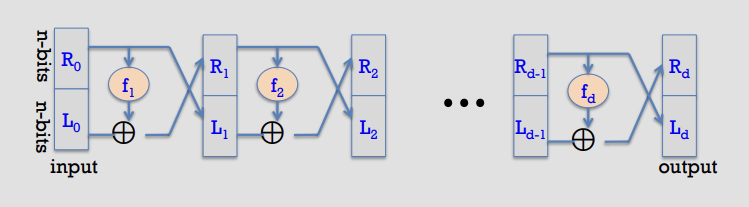
-
Forward (round
i): given(L_{i-1}, R_{i-1}) \in \{0,1\}^n \times \{0,1\}^n,L_i = R_{i-1}R_i = L_{i-1} \oplus f_i(R_{i-1})
-
Proof (construct the inverse):
- Suppose we are given the output of round
i, namely(L_i, R_i). - Recover the previous right half immediately:
R_{i-1} = L_i
- Then recover the previous left half by undoing the XOR:
L_{i-1} = R_i \oplus f_i(R_{i-1}) = R_i \oplus f_i(L_i)
- Therefore each round map is invertible, with inverse transformation:
R_{i-1} = L_iL_{i-1} = f_i(L_i) \oplus R_i
- Applying this inverse for
i=d,d-1,\ldots,1recovers(L_0,R_0)from(L_d,R_d), so the whole Feistel networkFis invertible.
- Suppose we are given the output of round
-
Notation sketch (each wire is
nbits):- Input:
(L_0, R_0) - Rounds:
L_1 = R_0,\ \ R_1 = L_0 \oplus f_1(R_0)L_2 = R_1,\ \ R_2 = L_1 \oplus f_2(R_1)\cdotsL_d = R_{d-1},\ \ R_d = L_{d-1} \oplus f_d(R_{d-1})
- Output:
(L_d, R_d)
- Input:
Block ciphers: block modes: ECB
New attacker model for multi-use keys (e.g. multiple blocks): CPA (Chosen Plaintext)-capable, not just CT-only
- Attacker sees many PT/CT pairs for same key
- Conservative model: attacker submits arbitrary PT (hence "C"PA)
- Cipher goal: maintain semantic security against CPA
CPA indistinguishability game
-
Updated adversarial game for a CPA attacker:
- Let
E = (E, D)be a cipher defined over(K, M, C). Forb \in \{0,1\}define\operatorname{EXP}(b)as:
- Let
-
Experiment
\operatorname{EXP}(b):- Challenger samples
k \leftarrow K. - For each query
i = 1,\ldots,q:- Adversary outputs messages
m_{i,0}, m_{i,1} \in Msuch that|m_{i,0}| = |m_{i,1}|. - Challenger returns
c_i \leftarrow E(k, m_{i,b}).
- Adversary outputs messages
- Challenger samples
-
Encryption-oracle access (CPA):
- If the adversary wants
c = E(k, m), it queries withm_{j,0} = m_{j,1} = m(so the response isE(k,m)regardless ofb).
- If the adversary wants
Semantic security under CPA
- Def:
Eis semantically secure under CPA if for all "efficient" adversariesA,\operatorname{Adv}^{\operatorname{CPA}}[A,E] = \left|\Pr[\operatorname{EXP}(0)=1] - \Pr[\operatorname{EXP}(1)=1]\right|- is negligible.
Summary for symmetric encrption
- Stream ciphers
- Rely on secure PRG
- No key re-use
- Fast, low-mem, less robust
- Block ciphers
- Rely on secure PRP
- Allow key re-use (usually only across blocks, not sessions)
- Provide authenticated encryption in some modes (e.g. GCM)
- Slower, higher-mem, more robust
- Used in practice for most crypto tasks (including secure network channels)
Hash functions
Hash function security properties
-
Given a function
h:X \to Y, we say thathis: -
- Preimage resistant (one-way) if:
- given
y \in Yit is computationally infeasible to find a valuex \in Xs.t.h(x) = y
-
- 2nd preimage resistant (weak collision resistant) if:
- given a specific
x \in Xit is computationally infeasible to find a valuex' \in Xs.t.x' \ne xandh(x') = h(x)
-
- Collision resistant (strong collision resistant) if:
- it is computationally infeasible to find any two distinct values
x', x \in Xs.t.h(x') = h(x)
Collision resistance: adversarial definition
- Let
H: M \to Tbe a hash function (|M| \gg |T|). - A function
His collision resistant if for all (explicit) "efficient" algorithmsA,- $\operatorname{Adv}^{\operatorname{CR}}[A,H] = Pr[$A outputs a collision for
H] - is negligible
- $\operatorname{Adv}^{\operatorname{CR}}[A,H] = Pr[$A outputs a collision for
Hash function integrity applications
- Delayed knowledge verification
- Password storage
- Trusted timestamping / blockchains
- Integrity check on software
File integrity with secure read-only space
- When user downloads package, can verify that contents are valid
Hcollision resistant\Rightarrowattacker cannot modify package without detection- No encryption needed (public verifiability) if publisher has secure read-only space (e.g. trusted website, social media account)
Symmetric-crypto message authentication
-
Context: Assume no secure RO space (insecure channel only)
- Need means of message authentication
-
Idea: add tag to message
-
System: Message Authentication Code (MAC)
-
Def: a MAC
I=(S,V)defined over(K,M,T)is a pair of algorithms:S(k,m)outputst \in T// "Sign"V(k,m,t)outputsyes' orno' // "Verify"
-
Symmetric-crypto message authentication:
- Alice and Bob share secret key
k - Generate tag:
\text{tag} \leftarrow S(k,m) - Verify tag:
V(k,m,\text{tag}) = \texttt{yes}?
- Alice and Bob share secret key
MAC security model
-
For a MAC
I=(S,V)and adversaryA, define a MAC game as: -
Def:
I=(S,V)is a secure MAC if for all "efficient"A,\operatorname{Adv}^{\operatorname{MAC}}[A,I] = \Pr[\text{Chal. outputs }1]- is negligible
-
MAC game (sketch):
- Challenger samples
k \leftarrow K - Adversary makes queries
m_1,\ldots,m_q \in M- For each
i, challenger returnst_i \leftarrow S(k,m_i)
- For each
- Adversary outputs a candidate forgery
(m,t) - Challenger outputs
b=1if:V(k,m,t)=\texttt{yes}and(m,t) \notin \{(m_1,t_1),\ldots,(m_q,t_q)\}
- Otherwise challenger outputs
b=0
- Challenger samples
-
MAC security example: secure PRF not sufficient
- Suppose
F: K \times X \to Yis a secure PRF withY=\{0,1\}^{10}. - Is the derived MAC
I_Fa secure MAC system?- No: tags are too short, anyone can guess the tag for any message
- Suppose
MACs from PRFs: sufficient security condition
- Thm: If
F: K \times X \to Yis a secure PRF and1/|Y|is negligible (i.e.|Y|is large), thenI_Fis a secure MAC. - In particular, for every efficient MAC adversary
AattackingI_F, there exists an efficient PRF adversaryBattackingFsuch that:\operatorname{Adv}^{\operatorname{MAC}}[A, I_F] \le \operatorname{Adv}^{\operatorname{PRF}}[B, F] + 1/|Y|
- Therefore
I_Fis secure as long as|Y|is large, e.g.|Y| = 2^{80}.
MACs from collision resistance
- Let
I=(S,V)be a MAC for short messages over(K,M,T)(e.g. AES). - Let
H: M_{\text{big}} \to M. - Def:
I_{\text{big}}=(S_{\text{big}},V_{\text{big}})over(K,M_{\text{big}},T)as:S_{\text{big}}(k,m) = S(k, H(m))V_{\text{big}}(k,m,t) = V(k, H(m), t)
- Thm: If
Iis a secure MAC andHis collision resistant, thenI_{\text{big}}is a secure MAC. - Example:
S(k,m) = \operatorname{AES2\text{-}block\text{-}cbc}(k, \operatorname{SHA\text{-}256}(m))is a secure MAC.
Using HMACs for confidentiality + integrity
- Confidentiality:
- Semantic security under a CPA
- Encryption secure against eavesdropping only
- Integrity:
- Existential unforgeability under a CPA
- CBC-MAC, HMAC
- Hash functions
- Confidentiality + integrity:
- CCA security
- Secure against tampering
- Method: Authenticated Encryption (AE)
- Encryption + MAC, in correct form
Authenticated Encryption: security defs
- An authenticated encryption system
(E,D)is a cipher where:E: K \times M \times N \to CD: K \times C \times N \to M \cupcipher text rejected
- Security: the system must provide
- semantic security under a CPA attack, and
- ciphertext integrity: attacker cannot create new ciphertexts that decrypt properly
Ciphertext integrity
-
Let
(E,D)be a cipher with message spaceM. -
Def:
(E,D)has ciphertext integrity if for all "efficient"A,\operatorname{Adv}^{\operatorname{CI}}[A,E] = \Pr[\text{Chal. outputs }1]- is negligible
-
Security model: ciphertext integrity (sketch):
- Challenger samples
k \leftarrow K - Adversary makes encryption queries
m_1,\ldots,m_q \in M- For each
i, challenger returnsc_i \leftarrow E(k,m_i)
- For each
- Adversary outputs a ciphertext
c - Challenger outputs
b=1if:D(k,c) \ne \botandc \notin \{c_1,\ldots,c_q\}
- Otherwise challenger outputs
b=0
- Challenger samples
Authenticated encryption implies CCA security
-
Thm: Let
(E,D)be a cipher that provides AE. Then(E,D)is CCA secure. -
In particular, for any $q$-query efficient adversary
A, there exist efficientB_1,B_2such that:\operatorname{Adv}^{\operatorname{CCA}}[A,E] \le 2q \cdot \operatorname{Adv}^{\operatorname{CI}}[B_1,E] + \operatorname{Adv}^{\operatorname{CPA}}[B_2,E]
-
Interpretation: CCA advantage is
\le O(\text{CT-integrity advantage}) + \text{CPA advantage}. -
AE implication: authenticity
- Attacker cannot fool Bob into thinking a message was sent from Alice
- If attacker cannot create a valid ciphertext
c \notin \{c_1,\ldots,c_q\}, then wheneverD(k,c) \ne \botBob knows the message is from someone who knowsk(but it could be a replay)
-
DS construction example: signing a certificate
Comparison: integrity/authentication approaches
-
- Collision resistant hashing: need a read-only public space
- Allows public verification if the hash is published in a small read-only public space
-
- MACs: must compute a new MAC for every client/user
- Must manage a long-term secret key per user to verify MACs (depending on application)
- Typically useful when one party signs, one verifies
-
- Digital signatures: must manage a long-term secret key
- E.g. vendor's signature on software is shipped with software
- Allows software to be downloaded from an untrusted distribution site
- Public-key verification/rejection works, provided public key distribution is trustworthy
- Typically useful when one party signs, many verify
Asymmetric key cryptography
Asymmetric crypto overview
- Parties: sender, recipient, attacker (eavesdropping)
- Goal: sender encrypts a plaintext to a ciphertext using a public key; recipient decrypts using a private key.
Public-key encryption system
- Def: a public-key encryption system is a triple of algorithms
(G, E, D):G(): randomized algorithm that outputs a key pair(pk, sk)E(pk, m): randomized algorithm that takesm \in Mand outputsc \in CD(sk, c): deterministic algorithm that takesc \in Cand outputsm \in Mor\bot
- Consistency: for all
(pk, sk)output byG, for allm \in M,D(sk, E(pk, m)) = m
Trapdoor function
- Def: a trapdoor function
X \to Yis a triple of efficient algorithms(G, F, F^{-1}):G(): randomized algorithm that outputs a key pair(pk, sk)F(pk, \cdot): deterministic algorithm that defines a functionX \to YF^{-1}(sk, \cdot): defines a functionY \to Xthat invertsF(pk, \cdot)
- More precisely: for all
(pk, sk)output byG, for allx \in X,F^{-1}(sk, F(pk, x)) = x
Symmetric vs. asymmetric security: attacker models
- Symmetric ciphers: two security notions for a passive attacker
- One-time security (stream ciphers: ciphertext-only)
- Many-time security (block ciphers: CPA)
- One-time security
\Rightarrowmany-time security - Example: ECB mode is one-time secure but not many-time secure
- Public-key encryption: single notion for a passive attacker
- Attacker can encrypt by themselves using the public key
- Therefore one-time security
\Rightarrowmany-time security (CPA) - Implication: public-key encryption must be randomized
- Analogous to secure block modes for block ciphers
Semantic security of asymmetric crypto (IND-CPA)
IND-CPA game for public-key encryption
-
For
b \in \{0,1\}define experiments\operatorname{EXP}(0)and\operatorname{EXP}(1): -
Experiment
\operatorname{EXP}(b):- Challenger runs
(pk, sk) \leftarrow G() - Challenger sends
pkto adversaryA - Adversary outputs
m_0, m_1 \in Msuch that|m_0| = |m_1| - Challenger returns
c \leftarrow E(pk, m_b) - Adversary outputs a bit
b' \in \{0,1\}(often modeled as outputting 1 if it "guesses $b=1$")
- Challenger runs
Semantic security (IND-CPA)
- Def:
E = (G, E, D)is semantically secure (a.k.a. IND-CPA) if for all efficient adversariesA,\operatorname{Adv}^{\operatorname{SS}}[A, E] = \left|\Pr[\operatorname{EXP}(0)=1] - \Pr[\operatorname{EXP}(1)=1]\right|- is negligible
- Note: inherently multiple-round because the attacker can always encrypt on their own using
pk(CPA power is "built in").
RSA cryptosystem: overview
-
Setup:
n = pq, withpandqprimes- Choose
erelatively prime to\phi(n) = (p-1)(q-1) - Choose
das the inverse ofein\mathbb{Z}_{\phi(n)}
-
Keys:
- Public key:
K_E = (n, e) - Private key:
K_D = d
- Public key:
-
Encryption:
- Plaintext
M \in \mathbb{Z}_n C = M^e \bmod n
- Plaintext
-
Decryption:
M = C^d \bmod n
-
Example:
- Setup:
p = 7,q = 17n = 7 \cdot 17 = 119\phi(n) = 6 \cdot 16 = 96e = 5d = 77
- Keys:
- public key:
(119, 5) - private key:
77
- public key:
- Encryption:
M = 19C = 19^5 \bmod 119 = 66
- Decryption:
M = 66^{77} \bmod 119 = 19
- Setup:
-
Security intuition:
- To invert RSA without
d, attacker must computexfromc = x^e \pmod n. - Best known approach:
- Step 1: factor
n(hard) - Step 2: compute $e$-th roots modulo
pandq(easy once factored)
- Step 1: factor
- Notes (as commonly stated in lectures):
- 1024-bit RSA is within reach; 2048-bit is recommended usage
- To invert RSA without
Diffie-Hellman key exchange (informal)
-
Fix a large prime
p(e.g., 2000 bits) -
Fix an integer
g \in \{1,\ldots,p\} -
Protocol:
- Alice chooses random
a \in \{1,\ldots,p-1\}and sendsA = g^a \bmod p - Bob chooses random
b \in \{1,\ldots,p-1\}and sendsB = g^b \bmod p - Shared key:
- Alice computes
k_{AB} = B^a \bmod p = g^{ab} \bmod p - Bob computes
k_{AB} = A^b \bmod p = g^{ab} \bmod p
- Alice computes
- Alice chooses random
-
Hardness assumptions:
- Discrete log problem: given
p, g, y = g^x \bmod p, findx - Diffie-Hellman function:
\operatorname{DH}_g(g^a, g^b) = g^{ab} \bmod p
- Discrete log problem: given
Diffie-Hellman: security notes
- As described, the protocol is insecure against active attacks:
- A man-in-the-middle (MiTM) can insert themselves and create 2 separate secure sessions
- Fix idea: need a way to bind identity to a public key
- In practice: web of trust (e.g., GPG) or Public Key Infrastructure (PKI)
Implementing trapdoor functions securely
-
Never encrypt by applying
Fdirectly to plaintext:- Deterministic: cannot be semantically secure
- Many attacks exist for concrete TDFs
- Same plaintext blocks yield same ciphertext blocks
-
Naive (insecure) sketch:
E(pk, m): outputc \leftarrow F(pk, m)D(sk, c): outputF^{-1}(sk, c)
Public-key encryption from TDFs
-
Components:
(G, F, F^{-1}): secure TDFX \to Y(E_s, D_s): symmetric authenticated encryption over(K, M, C)H: X \to K: a hash function
-
Construction of
(G, E, D)(withGsame as in the TDF):E(pk, m):- sample
x \leftarrow X, computey \leftarrow F(pk, x) - derive
k \leftarrow H(x), computec \leftarrow E_s(k, m) - output
(y, c)
- sample
D(sk, (y, c)):- compute
x \leftarrow F^{-1}(sk, y) - derive
k \leftarrow H(x), computem \leftarrow D_s(k, c) - output
m
- compute
-
Visual intuition:
- header:
y = F(pk, x) - body:
c = E_s(H(x), m)
- header:
-
Security theorem (lecture-style statement):
- If
(G, F, F^{-1})is a secure TDF,(E_s, D_s)provides authenticated encryption, andHis modeled as a random oracle, then(G, E, D)is CCA-secure in the random oracle model (often denoted CCA-RO). - Extension exists to reach full CCA (outside the RO idealization).
- If
Wrapup: symmetric vs. asymmetric systems
- Symmetric: faster, but key distribution is hard
- Asymmetric: slower, but key distribution/management is easier
- Application: secure web sessions (e.g., online shopping)
- Use symmetric-key encrypted sessions for bulk traffic
- Exchange symmetric keys using an asymmetric scheme
- Authenticate public keys (PKI or web of trust)
Key exchange: summary
-
Symmetric-key encryption challenges:
- Key storage: one per user pair,
O(n^2)total fornusers - Key exchange: how to do it over a non-secure channel?
- Key storage: one per user pair,
-
Possible solutions:
-
- Trusted Third Party (TTP)
- All users establish separate secret keys with the TTP
- TTP helps manage user-user keys (storage and secure channel)
- Applicability:
- Works for local domains
- Popular implementation: Kerberos for Single Sign On (SSO)
- Challenges:
- Scale: central authentication server is not suitable for the entire Internet
- Latency: requires online response from central server for every user-user session
-
- Public/private keys with certificates
- All users have a single stable public key (helps with key storage and exchange)
- Users exchange per-session symmetric keys via a secure channel using public/private keys
- Trusting public keys: binding is validated by a third-party authority (Certificate Authority, CA)
- Why better than TTP? CAs can validate statically by issuing certificates, then be uninvolved
- CA/certificate process covered in a future lecture
Appendix for additional algorithms and methods
Feistel network (used by several items below)
A Feistel network splits a block into left/right halves and iterates rounds of the form (L_{i+1},R_{i+1})=(R_i, L_i\oplus F(R_i,K_i)), so decryption reuses the same structure with subkeys in reverse order.
Feistel-based here: DES, 3DES, CAMELLIA, SEED, GOST 28147-89 (and thus GOST89MAC uses a Feistel block cipher internally).
Key exchange and authentication selectors (not symmetric encryption, not MAC)
These describe *how keys are negotiated- and/or how the peer is authenticated, not whether payload is a block/stream cipher.
RSA / DH / ECDH families
- kRSA, RSA — (key exchange) the premaster secret is sent encrypted under the server’s RSA public key (classic TLS RSA KX).
- aRSA, aECDSA, aDSS, aGOST, aGOST01 — (authentication) the server identity is proven via a certificate signature scheme (RSA / ECDSA / DSA / GOST).
- kDHr, kDHd, kDH — (key exchange) *static- DH key agreement using DH certificates (obsolete/removed in newer OpenSSL).
- kDHE, kEDH, DH / DHE, EDH / ECDHE, EECDH / kEECDH, kECDHE, ECDH — (key exchange) *ephemeral- (EC)DH derives a fresh shared secret each handshake; "authenticated" variants bind it to a cert/signature.
- aDH — (authentication selector) indicates DH-authenticated suites (DH certs; also removed in newer OpenSSL).
PSK family
- PSK — (keying model) uses a pre-shared secret as the authentication/secret basis.
- kPSK, kECDHEPSK, kDHEPSK, kRSAPSK — (key exchange) PSK combined with (EC)DHE or RSA to derive/transport session keys.
- aPSK — (authentication) PSK itself authenticates endpoints (except RSA_PSK where cert auth may be involved).
Symmetric encryption / AEAD (this is where "block vs stream" applies)
AES family
- AES128 / AES256 / AES — encryption/decryption; block cipher; core algorithm: AES is an SPN (substitution–permutation network) of repeated SubBytes/ShiftRows/MixColumns/AddRoundKey rounds.
- AES-GCM — both encryption + message authentication (AEAD); both (AES block cipher used in counter mode + auth); core algorithm: encrypt with AES-CTR and authenticate with GHASH over ciphertext/AAD to produce a tag.
- AES-ECB: Functionality is encryption/decryption (confidentiality only) using a block cipher mode; core algorithm encrypts each 128-bit plaintext block independently under the same key, which deterministically leaks patterns because equal plaintext blocks map to equal ciphertext blocks.
- AES-CBC: Functionality is encryption/decryption (confidentiality only) using a block cipher mode; core algorithm XORs each plaintext block with the previous ciphertext block (starting from a fresh unpredictable IV) before AES-encrypting, which hides repetitions but requires correct IV handling and padding for non-multiple-of-block messages.
- AES-OFB — encryption; both (stream-like); repeatedly AES-encrypts an internal state to generate a keystream and XORs it with plaintext, where the state evolves independently of the plaintext/ciphertext.
- AESCCM / AESCCM8 — both encryption + message authentication (AEAD); both; core algorithm: compute CBC-MAC then encrypt with CTR mode, with 16-byte vs 8-byte tag length variants.
ARIA family
- ARIA128 / ARIA256 / ARIA — encryption/decryption; block cipher; core algorithm: ARIA is an SPN-style block cipher with byte-wise substitutions and diffusion layers across rounds.
CAMELLIA family
- CAMELLIA128 / CAMELLIA256 / CAMELLIA — encryption/decryption; block cipher; core algorithm: Camellia is a Feistel network with round functions plus extra FL/FL$^{-1}$ layers for nonlinearity and diffusion. (Feistel: yes)
ChaCha20
- CHACHA20 — encryption/decryption; stream cipher; core algorithm: ChaCha20 generates a keystream via repeated ARX (add-rotate-xor) quarter-rounds on a 512-bit state and XORs it with plaintext.
DES / 3DES
- DES — encryption/decryption; block cipher; core algorithm: DES is a 16-round Feistel network using expansion, S-boxes, and permutations. (Feistel: yes)
- 3DES — encryption/decryption; block cipher; core algorithm: applies DES three times (EDE or EEE) to increase effective security while retaining the Feistel DES core. (Feistel: yes)
RC4
- RC4 — encryption/decryption; stream cipher; core algorithm: maintains a 256-byte permutation and produces a keystream byte-by-byte that is XORed with plaintext.
RC2 / IDEA / SEED
- RC2 — encryption/decryption; block cipher; core algorithm: mixes key-dependent operations (adds, XORs, rotates) across rounds with "mix" and "mash" steps (not Feistel).
- IDEA — encryption/decryption; block cipher; core algorithm: combines modular addition, modular multiplication, and XOR in a Lai–Massey-like structure to achieve diffusion/nonlinearity (not Feistel).
- SEED — encryption/decryption; block cipher; core algorithm: a 16-round Feistel network with nonlinear S-box-based round functions. (Feistel: yes)
Hash / MAC / digest selectors (message authentication side)
These are not "ciphers" but are used for integrity/authentication (often as HMAC, PRF, signatures).
- MD5 — message authentication component (typically via HMAC, historically); cipher method: N/A; core algorithm: iterated Merkle–Damgård hash compressing 512-bit blocks into a 128-bit digest (now considered broken for collision resistance).
- SHA1, SHA — message authentication component (typically HMAC-SHA1 historically); N/A; core algorithm: Merkle–Damgård hash producing 160-bit output via 80-step compression (collisions known).
- SHA256 / SHA384 — message authentication component (HMAC / TLS PRF / signatures); N/A; core algorithm: SHA-2 family Merkle–Damgård hashes with different word sizes/output lengths (256-bit vs 384-bit).
- GOST94 — message authentication component (HMAC based on GOST R 34.11-94); N/A; core algorithm: builds an HMAC tag by hashing inner/outer padded key with the message using the GOST hash.
- GOST89MAC — message authentication; block-cipher-based MAC (so "block" internally); core algorithm: computes a MAC using the GOST 28147-89 block cipher in a MAC mode (cipher-based chaining). (Feistel internally via GOST 28147-89)
Latest version of cheatsheet distilled from this note.