
352 lines
12 KiB
Markdown
352 lines
12 KiB
Markdown
# Math401 Topic 3: Separable Hilbert spaces
|
|
|
|
## Infinite-dimensional Hilbert spaces
|
|
|
|
Recall from Topic 1.
|
|
|
|
[$L^2$ space](https://notenextra.trance-0.com/Math401/Math401_T1#section-3-further-definitions-in-measure-theory-and-integration)
|
|
|
|
Let $\lambda$ be a measure on $\mathbb{R}$, or any other field you are interested in.
|
|
|
|
A function is square integrable if
|
|
|
|
$$
|
|
\int_\mathbb{R} |f(x)|^2 d\lambda(x)<\infty
|
|
$$
|
|
|
|
### $L^2$ space and general Hilbert spaces
|
|
|
|
#### Definition of $L^2(\mathbb{R},\lambda)$
|
|
|
|
The space $L^2(\mathbb{R},\lambda)$ is the space of all square integrable, measurable functions on $\mathbb{R}$ with respect to the measure $\lambda$ (The Lebesgue measure).
|
|
|
|
The Hermitian inner product is defined by
|
|
|
|
$$
|
|
\langle f,g\rangle=\int_\mathbb{R} \overline{f(x)}g(x) d\lambda(x)
|
|
$$
|
|
|
|
The norm is defined by
|
|
|
|
$$
|
|
\|f\|=\sqrt{\int_\mathbb{R} |f(x)|^2 d\lambda(x)}
|
|
$$
|
|
|
|
The space $L^2(\mathbb{R},\lambda)$ is complete.
|
|
|
|
[Proof ignored here]
|
|
|
|
> Recall the definition of [complete metric space](https://notenextra.trance-0.com/Math4111/Math4111_L17#definition-312).
|
|
|
|
The inner product space $L^2(\mathbb{R},\lambda)$ is complete.
|
|
|
|
> Note that **by some general result in point-set topology**, a normed vector space can always be enlarged so as to become complete. This process is called completion of the normed space.
|
|
>
|
|
> Some exercise is showing some hints for this result:
|
|
>
|
|
> Show that the subspace of $L^2(\mathbb{R},\lambda)$ consisting of square integrable continuous functions is not closed.
|
|
>
|
|
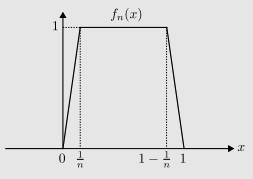
> Suggestion: consider the sequence of continuous functions $f_1(x), f_2(x),\cdots$, where $f_n(x)$ is defined by the following graph:
|
|
>
|
|
> 
|
|
>
|
|
> Show that $f_n$ converges in the $L^2$ norm to a function $f\in L^2(\mathbb{R},\lambda)$ but the limit function $f$ is not continuous. Draw the graph of $f_n$ to make this clear.
|
|
|
|
#### Definition of general Hilbert space
|
|
|
|
A Hilbert space is a complete inner product vector space.
|
|
|
|
#### General Pythagorean theorem
|
|
|
|
Let $u_1,u_2,\cdots,u_N$ be an orthonormal set in an inner product space $\mathscr{V}$ (may not be complete). Then for all $v\in \mathscr{V}$,
|
|
|
|
$$
|
|
\|v\|^2=\sum_{i=1}^N |\langle v,u_i\rangle|^2+\left\|v-\sum_{i=1}^N \langle v,u_i\rangle u_i\right\|^2
|
|
$$
|
|
|
|
[Proof ignored here]
|
|
|
|
#### Bessel's inequality
|
|
|
|
Let $u_1,u_2,\cdots,u_N$ be an orthonormal set in an inner product space $\mathscr{V}$ (may not be complete). Then for all $v\in \mathscr{V}$,
|
|
|
|
$$
|
|
\sum_{i=1}^N |\langle v,u_i\rangle|^2\leq \|v\|^2
|
|
$$
|
|
|
|
Immediate from the general Pythagorean theorem.
|
|
|
|
### Orthonormal bases
|
|
|
|
An orthonormal subset $S$ of a Hilbert space $\mathscr{H}$ is a set all of whose elements have norm 1 and are mutually orthogonal. ($\forall u,v\in S, \langle u,v\rangle=0$)
|
|
|
|
#### Definition of orthonormal basis
|
|
|
|
An orthonormal subset of $S$ of a Hilbert space $\mathscr{H}$ is an orthonormal basis of $\mathscr{H}$ if there are no other orthonormal subsets of $\mathscr{H}$ that contain $S$ as a proper subset.
|
|
|
|
#### Theorem of existence of orthonormal basis
|
|
|
|
Every separable Hilbert space has an orthonormal basis.
|
|
|
|
[Proof ignored here]
|
|
|
|
#### Theorem of Fourier series
|
|
|
|
Let $\mathscr{H}$ be a separable Hilbert space with an orthonormal basis $\{e_n\}$. Then for any $f\in \mathscr{H}$,
|
|
|
|
$$
|
|
f=\sum_{n=1}^\infty \langle f,e_n\rangle e_n
|
|
$$
|
|
|
|
The series converges to some $g\in \mathscr{H}$.
|
|
|
|
[Proof ignored here]
|
|
|
|
#### Fourier series in $L^2([0,2\pi],\lambda)$
|
|
|
|
Let $f\in L^2([0,2\pi],\lambda)$.
|
|
|
|
$$
|
|
f_N(x)=\sum_{n:|n|\leq N} c_n\frac{e^{inx}}{\sqrt{2\pi}}
|
|
$$
|
|
|
|
where $c_n=\frac{1}{2\pi}\int_0^{2\pi} f(x)e^{-inx} dx$.
|
|
|
|
The series converges to some $f\in L^2([0,2\pi],\lambda)$ as $N\to \infty$.
|
|
|
|
This is the Fourier series of $f$.
|
|
|
|
#### Hermite polynomials
|
|
|
|
The subspace spanned by polynomials is dense in $L^2(\mathbb{R},\lambda)$.
|
|
|
|
An orthonormal basis of $L^2(\mathbb{R},\lambda)$ can be obtained by the Gram-Schmidt process on $\{1,x,x^2,\cdots\}$.
|
|
|
|
The polynomials are called the Hermite polynomials.
|
|
|
|
### Isomorphism and $\ell_2$ space
|
|
|
|
#### Definition of isomorphic Hilbert spaces
|
|
|
|
Let $\mathscr{H}_1$ and $\mathscr{H}_2$ be two Hilbert spaces.
|
|
|
|
$\mathscr{H}_1$ and $\mathscr{H}_2$ are isomorphic if there exists a surjective linear map $U:\mathscr{H}_1\to \mathscr{H}_2$ that is bijective and preserves the inner product.
|
|
|
|
$$
|
|
\langle Uf,Ug\rangle=\langle f,g\rangle
|
|
$$
|
|
|
|
for all $f,g\in \mathscr{H}_1$.
|
|
|
|
When $\mathscr{H}_1=\mathscr{H}_2$, the map $U$ is called unitary.
|
|
|
|
#### $\ell_2$ space
|
|
|
|
The space $\ell_2$ is the space of all square summable sequences.
|
|
|
|
$$
|
|
\ell_2=\left\{(a_n)_{n=1}^\infty: \sum_{n=1}^\infty |a_n|^2<\infty\right\}
|
|
$$
|
|
|
|
An example of element in $\ell_2$ is $(1,0,0,\cdots)$.
|
|
|
|
With inner product
|
|
|
|
$$
|
|
\langle (a_n)_{n=1}^\infty, (b_n)_{n=1}^\infty\rangle=\sum_{n=1}^\infty \overline{a_n}b_n
|
|
$$
|
|
|
|
It is a Hilbert space (every Cauchy sequence in $\ell_2$ converges to some element in $\ell_2$).
|
|
|
|
### Bounded operators and continuity
|
|
|
|
Let $T:\mathscr{V}\to \mathscr{W}$ be a linear map between two vector spaces $\mathscr{V}$ and $\mathscr{W}$.
|
|
|
|
We define the norm of $\|\cdot\|$ on $\mathscr{V}$ and $\mathscr{W}$.
|
|
|
|
Then $T$ is continuous if for all $u\in \mathscr{V}$, if $u_n\to u$ in $\mathscr{V}$, then $T(u_n)\to T(u)$ in $\mathscr{W}$.
|
|
|
|
Using the delta-epsilon language, we can say that $T$ is continuous if for all $\epsilon>0$, there exists a $\delta>0$ such that if $\|u-v\|<\delta$, then $\|T(u)-T(v)\|<\epsilon$.
|
|
|
|
#### Definition of bounded operator
|
|
|
|
A linear map $T:\mathscr{V}\to \mathscr{W}$ is bounded if
|
|
|
|
$$
|
|
\|T\|=\sup_{\|u\|=1}\|T(u)\|< \infty
|
|
$$
|
|
|
|
#### Theorem of continuity and boundedness
|
|
|
|
A linear map $T:\mathscr{V}\to \mathscr{W}$ is continuous if and only if it is bounded.
|
|
|
|
[Proof ignored here]
|
|
|
|
#### Definition of bounded Hilbert space
|
|
|
|
The set of all bounded linear operators in $\mathscr{V}$ is denoted by $\mathscr{B}(\mathscr{V})$.
|
|
|
|
### Direct sum of Hilbert spaces
|
|
|
|
Suppose $\mathscr{H}_1$ and $\mathscr{H}_2$ are two Hilbert spaces.
|
|
|
|
The direct sum of $\mathscr{H}_1$ and $\mathscr{H}_2$ is the Hilbert space $\mathscr{H}_1\oplus \mathscr{H}_2$ with the inner product
|
|
|
|
$$
|
|
\langle (u_1,u_2),(v_1,v_2)\rangle=\langle u_1,v_1\rangle_{\mathscr{H}_1}+\langle u_2,v_2\rangle_{\mathscr{H}_2}
|
|
$$
|
|
|
|
Such space is denoted by $\mathscr{H}_1\oplus \mathscr{H}_2$.
|
|
|
|
A countable direct sum of Hilbert spaces can be defined similarly, as long as it is bounded.
|
|
|
|
That is, $\{u_n:n=1,2,\cdots\}$ is a sequence of elements in $\mathscr{H}_n$, and $\sum_{n=1}^\infty \|u_n\|^2<\infty$.
|
|
|
|
The inner product in such countable direct sum is defined by
|
|
|
|
$$
|
|
\langle (u_n)_{n=1}^\infty, (v_n)_{n=1}^\infty\rangle=\sum_{n=1}^\infty \langle u_n,v_n\rangle_{\mathscr{H}_n}
|
|
$$
|
|
|
|
Such space is denoted by $\mathscr{H}=\bigoplus_{n=1}^\infty \mathscr{H}_n$.
|
|
|
|
### Closed subspaces of Hilbert spaces
|
|
|
|
#### Definition of closed subspace
|
|
|
|
A subspace $\mathscr{M}$ of a Hilbert space $\mathscr{H}$ is closed if every convergent sequence in $\mathscr{M}$ converges to some element in $\mathscr{M}$.
|
|
|
|
#### Definition of pairwise orthogonal subspaces
|
|
|
|
Two subspaces $\mathscr{M}_1$ and $\mathscr{M}_2$ of a Hilbert space $\mathscr{H}$ are pairwise orthogonal if $\langle u,v\rangle=0$ for all $u\in \mathscr{M}_1$ and $v\in \mathscr{M}_2$.
|
|
|
|
### Orthogonal projections
|
|
|
|
#### Definition of orthogonal complement
|
|
|
|
The orthogonal complement of a subspace $\mathscr{M}$ of a Hilbert space $\mathscr{H}$ is the set of all elements in $\mathscr{H}$ that are orthogonal to every element in $\mathscr{M}$.
|
|
|
|
It is denoted by $\mathscr{M}^\perp=\{u\in \mathscr{H}: \langle u,v\rangle=0,\forall v\in \mathscr{M}\}$.
|
|
|
|
#### Projection theorem
|
|
|
|
Let $\mathscr{H}$ be a Hilbert space and $\mathscr{M}$ be a closed subspace of $\mathscr{H}$. Then for any $v\in \mathscr{H}$ can be uniquely decomposed as $v=u+w$ where $u\in \mathscr{M}$ and $w\in \mathscr{M}^\perp$.
|
|
|
|
[Proof ignored here]
|
|
|
|
### Dual Hilbert spaces
|
|
|
|
#### Norm of linear functionals
|
|
|
|
Let $\mathscr{H}$ be a Hilbert space.
|
|
|
|
The norm of a linear functional $f\in \mathscr{H}^*$ is defined by
|
|
|
|
$$
|
|
\|f\|=\sup_{\|u\|=1}|f(u)|
|
|
$$
|
|
|
|
#### Definition of dual Hilbert space
|
|
|
|
The dual Hilbert space of $\mathscr{H}$ is the space of all bounded linear functionals on $\mathscr{H}$.
|
|
|
|
It is denoted by $\mathscr{H}^*$.
|
|
|
|
$$
|
|
\mathscr{H}^*=\mathscr{B}(\mathscr{H},\mathbb{C})=\{f: \mathscr{H}\to \mathbb{C}: f\text{ is linear and }\|f\|<\infty\}
|
|
$$
|
|
|
|
You can exchange the $\mathbb{C}$ with any other field you are interested in.
|
|
|
|
#### The Riesz lemma
|
|
|
|
For each $f\in \mathscr{H}^*$, there exists a unique $v_f\in \mathscr{H}$ such that $f(u)=\langle u,v_f\rangle$ for all $u\in \mathscr{H}$. And $\|f\|=\|v_f\|$.
|
|
|
|
[Proof ignored here]
|
|
|
|
#### Definition of bounded sesqilinear form
|
|
|
|
A bounded sesqilinear form on $\mathscr{H}$ is a function $B: \mathscr{H}\times \mathscr{H}\to \mathbb{C}$ satisfying
|
|
|
|
1. $B(u,av+bw)=aB(u,v)+bB(u,w)$ for all $u,v,w\in \mathscr{H}$ and $a,b\in \mathbb{C}$.
|
|
2. $B(av+bw,u)=\overline{a}B(v,u)+\overline{b}B(w,u)$ for all $u,v,w\in \mathscr{H}$ and $a,b\in \mathbb{C}$.
|
|
3. $|B(u,v)|\leq C\|u\|\|v\|$ for all $u,v\in \mathscr{H}$ and some constant $C>0$.
|
|
|
|
There exists a unique bounded linear operator $A\in \mathscr{B}(\mathscr{H})$ such that $B(u,v)=\langle Au,v\rangle$ for all $u,v\in \mathscr{H}$. The norm of $A$ is the smallest constant $C$ such that $|B(u,v)|\leq C\|u\|\|v\|$ for all $u,v\in \mathscr{H}$.
|
|
|
|
[Proof ignored here]
|
|
|
|
### The adjoint of a bounded operator
|
|
|
|
Let $A\in \mathscr{B}(\mathscr{H})$. And bounded sesqilinear form $B: \mathscr{H}\times \mathscr{H}\to \mathbb{C}$ such that $B(u,v)=\langle u,Av\rangle$ for all $u,v\in \mathscr{H}$. Then there exists a unique bounded linear operator $A^*\in \mathscr{B}(\mathscr{H})$ such that $B(u,v)=\langle A^*u,v\rangle$ for all $u,v\in \mathscr{H}$.
|
|
|
|
[Proof ignored here]
|
|
|
|
And $\|A^*\|=\|A\|$.
|
|
|
|
Additional properties of bounded operators:
|
|
|
|
Let $A,B\in \mathscr{B}(\mathscr{H})$ and $a,b\in \mathbb{C}$. Then
|
|
|
|
1. $(aA+bB)^*=\overline{a}A^*+\overline{b}B^*$.
|
|
2. $(AB)^*=B^*A^*$.
|
|
3. $(A^*)^*=A$.
|
|
4. $\|A^*\|=\|A\|$.
|
|
5. $\|A^*A\|=\|A\|^2$.
|
|
|
|
#### Definition of self-adjoint operator
|
|
|
|
An operator $A\in \mathscr{B}(\mathscr{H})$ is self-adjoint if $A^*=A$.
|
|
|
|
#### Definition of normal operator
|
|
|
|
An operator $N\in \mathscr{B}(\mathscr{H})$ is normal if $NN^*=N^*N$.
|
|
|
|
#### Definition of unitary operator
|
|
|
|
An operator $U\in \mathscr{B}(\mathscr{H})$ is unitary if $U^*U=UU^*=I$.
|
|
|
|
where $I$ is the identity operator on $\mathscr{H}$.
|
|
|
|
#### Definition of orthogonal projection
|
|
|
|
An operator $P\in \mathscr{B}(\mathscr{H})$ is an orthogonal projection if $P^*=P$ and $P^2=P$.
|
|
|
|
### Tensor product of (infinite-dimensional) Hilbert spaces
|
|
|
|
#### Definition of tensor product
|
|
|
|
Let $\mathscr{H}_1$ and $\mathscr{H}_2$ be two Hilbert spaces. $u_1\in \mathscr{H}_1$ and $u_2\in \mathscr{H}_2$. Then $u_1\otimes u_2$ is an conjugate bilinear functional on $\mathscr{H}_1\times \mathscr{H}_2$.
|
|
|
|
$$
|
|
(u_1\otimes u_2)(v_1,v_2)=\langle u_1,v_1\rangle_{\mathscr{H}_1}\langle u_2,v_2\rangle_{\mathscr{H}_2}
|
|
$$
|
|
|
|
Let $\mathscr{V}$ be the set of all finite lienar combination of such conjugate bilinear functionals. We define the inner product on $\mathscr{V}$ by
|
|
|
|
$$
|
|
\langle u\otimes v,u'\otimes v'\rangle=\langle u,u'\rangle_{\mathscr{H}_1}\langle v,v'\rangle_{\mathscr{H}_2}
|
|
$$
|
|
|
|
The infinite-dimensional tensor product of $\mathscr{H}_1$ and $\mathscr{H}_2$ is the completion (extension of those bilinear functionals to make the set closed) of $\mathscr{V}$ with respect to the norm induced by the inner product.
|
|
|
|
Denoted by $\mathscr{H}_1\otimes \mathscr{H}_2$.
|
|
|
|
The orthonormal basis of $\mathscr{H}_1\otimes \mathscr{H}_2$ is $\{u_i\otimes v_j:i=1,2,\cdots,j=1,2,\cdots\}$. where $u_i$ is the orthonormal basis of $\mathscr{H}_1$ and $v_j$ is the orthonormal basis of $\mathscr{H}_2$.
|
|
|
|
### Fock space
|
|
|
|
#### Definition of Fock space
|
|
|
|
Let $\mathscr{H}^{\otimes n}$ be the $n$-fold tensor product of $\mathscr{H}$.
|
|
|
|
Set $\mathscr{H}^{\otimes 0}=\mathbb{C}$.
|
|
|
|
The Fock space of $\mathscr{H}$ is the direct sum of all $\mathscr{H}^{\otimes n}$.
|
|
|
|
$$
|
|
\mathscr{F}(\mathscr{H})=\bigoplus_{n=0}^\infty \mathscr{H}^{\otimes n}
|
|
$$
|
|
|
|
For example, if $\mathscr{H}=L^2(\mathbb{R},\lambda)$, then an element in $\mathscr{F}(\mathscr{H})$ is a sequence of functions $\psi=(\psi_0,\psi_1(x_1),\psi_2(x_1,x_2),\cdots)$ such that $|\psi_0|^2+\sum_{n=1}^\infty \int|\psi_n(x_1,\cdots,x_n)|^2dx_1\cdots dx_n<\infty$.
|