
5.9 KiB
CSE559A Lecture 22
Continue on Robust Fitting of parametric models
RANSAC
Definition: RANdom SAmple Consensus
RANSAC is a method to fit a model to a set of data points.
It is a non-deterministic algorithm that can be used to fit a model to a set of data points.
Pros:
- Simple and general
- Applicable to many different problems
- Often works well in practice
Cons:
- Lots of parameters to set
- Number of iterations grows exponentially as outlier ratio increases
- Can't always get a good initialization of the model based on the minimum number of samples.
Hough Transform
Use point-line duality to find lines.
In practice, we don't use (m,b) parameterization.
Instead, we use polar parameterization:
\rho = x \cos \theta + y \sin \theta
Algorithm outline:
- Initialize accumulator
Hto all zeros- For each feature point
(x,y)- For
\theta = 0to180 \rho = x \cos \theta + y \sin \thetaH(\theta, \rho) += 1
- For
- For each feature point
- Find the value(s) of
(\theta, \rho)whereH(\theta, \rho)is a local maximum (perform NMS on the accumulator array)- The detected line in the image is given by
\rho = x \cos \theta + y \sin \theta
- The detected line in the image is given by
Effect of noise
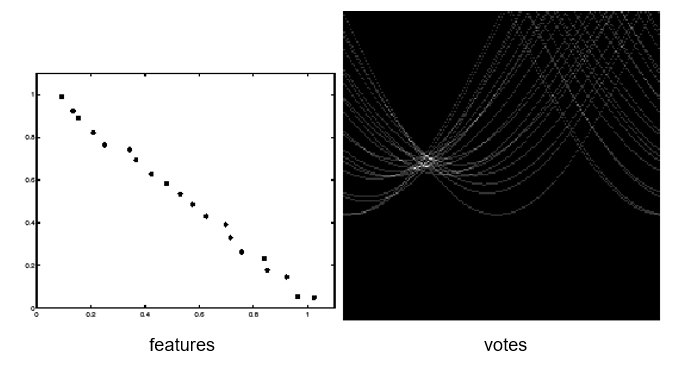
Noise makes the peak fuzzy.
Effect of outliers
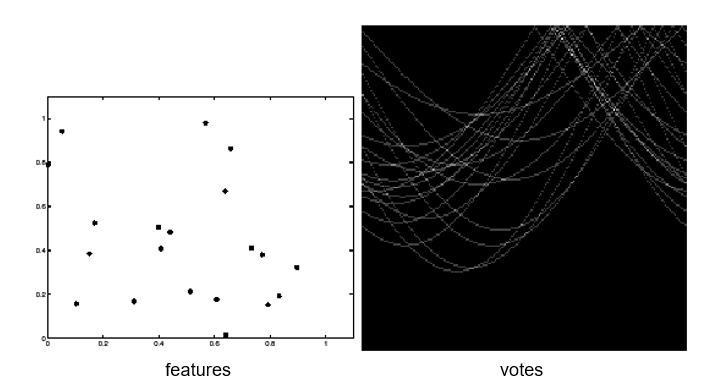
Outliers can break the peak.
Pros and Cons
Pros:
- Can deal with non-locality and occlusion
- Can detect multiple instances of a model
- Some robustness to noise: noise points unlikely to contribute consistently to any single bin
- Leads to a surprisingly general strategy for shape localization (more on this next)
Cons:
- Complexity increases exponentially with the number of model parameters
- In practice, not used beyond three or four dimensions
- Non-target shapes can produce spurious peaks in parameter space
- It's hard to pick a good grid size
Generalize Hough Transform
Template representation: for each type of landmark point, store all possible displacement vectors towards the center
Detecting the template:
For each feature in a new image, look up that feature type in the model and vote for the possible center locations associated with that type in the model
Implicit shape models
Training:
- Build codebook of patches around extracted interest points using clustering
- Map the patch around each interest point to closest codebook entry
- For each codebook entry, store all positions it was found, relative to object center
Testing:
- Given test image, extract patches, match to codebook entry
- Cast votes for possible positions of object center
- Search for maxima in voting space
- Extract weighted segmentation mask based on stored masks for the codebook occurrences
Image alignment
Affine transformation
Simple fitting procedure: linear least squares Approximates viewpoint changes for roughly planar objects and roughly orthographic cameras Can be used to initialize fitting for more complex models
Fitting an affine transformation:
\begin{bmatrix}
&&&\cdots\\
x_i & y_i & 0&0&1&0\\
0&0&x_i&y_i&0&1\\
&&&\cdots\\
\end{bmatrix}
\begin{bmatrix}
m_1\\
m_2\\
m_3\\
m_4\\
t_1\\
t_2\\
\end{bmatrix}
=
\begin{bmatrix}
\cdots\\
\end{bmatrix}
Only need 3 points to solve for 6 parameters.
Homography
Recall that
x' = \frac{a x + b y + c}{g x + h y + i}, \quad y' = \frac{d x + e y + f}{g x + h y + i}
Use 2D homogeneous coordinates:
(x,y) \rightarrow \begin{pmatrix}x \\ y \\ 1\end{pmatrix}
\begin{pmatrix}x\\y\\w\end{pmatrix} \rightarrow (x/w,y/w)
Reminder: all homogeneous coordinate vectors that are (non-zero) scalar multiples of each other represent the same point
Equation for homography in homogeneous coordinates:
\begin{pmatrix}
x' \\
y' \\
1
\end{pmatrix}
\cong
\begin{pmatrix}
h_{11} & h_{12} & h_{13} \\
h_{21} & h_{22} & h_{23} \\
h_{31} & h_{32} & h_{33}
\end{pmatrix}
\begin{pmatrix}
x \\
y \\
1
\end{pmatrix}
Constraint from a match (x_i,x_i'), x_i'\cong Hx_i
How can we get rid of the scale ambiguity?
Cross product trick:$x_i' × Hx_i=0$
The cross product is defined as:
\begin{pmatrix}a\\b\\c\end{pmatrix} \times \begin{pmatrix}a'\\b'\\c'\end{pmatrix} = \begin{pmatrix}bc'-b'c\\ca'-c'a\\ab'-a'b\end{pmatrix}
Let h_1^T, h_2^T, h_3^T be the rows of H. Then
x_i' × Hx_i=\begin{pmatrix}
    x_i' \\
    y_i' \\
    1
\end{pmatrix} \times \begin{pmatrix}
    h_1^T x_i \\
    h_2^T x_i \\
    h_3^T x_i
\end{pmatrix}
=
\begin{pmatrix}
    y_i' h_3^T x_i−h_2^T x_i \\
    h_1^T x_i−x_i' h_3^T x_i \\
    x_i' h_2^T x_i−y_i' h_1^T x_i
\end{pmatrix}
Constraint from a match (x_i,x_i'):
x_i' × Hx_i=\begin{pmatrix}
    x_i' \\
    y_i' \\
    1
\end{pmatrix} \times \begin{pmatrix}
    h_1^T x_i \\
    h_2^T x_i \\
    h_3^T x_i
\end{pmatrix}
=
\begin{pmatrix}
    y_i' h_3^T x_i−h_2^T x_i \\
    h_1^T x_i−x_i' h_3^T x_i \\
    x_i' h_2^T x_i−y_i' h_1^T x_i
\end{pmatrix}
Rearranging the terms:
\begin{bmatrix}
    0^T &-x_i^T &y_i' x_i^T \\
    x_i^T &0^T &-x_i' x_i^T \\
    y_i' x_i^T &x_i' x_i^T &0^T
\end{bmatrix}
\begin{bmatrix}
    h_1 \\
    h_2 \\
    h_3
\end{bmatrix} = 0
These equations aren't independent! So, we only need two.
Robust alignment
Descriptor-based feature matching
Extract features Compute putative matches Loop:
- Hypothesize transformation
T - Verify transformation (search for other matches consistent with
T)
RANSAC
Even after filtering out ambiguous matches, the set of putative matches still contains a very high percentage of outliers
RANSAC loop:
- Randomly select a seed group of matches
- Compute transformation from seed group
- Find inliers to this transformation
- If the number of inliers is sufficiently large, re-compute least-squares estimate of transformation on all of the inliers
At the end, keep the transformation with the largest number of inliers